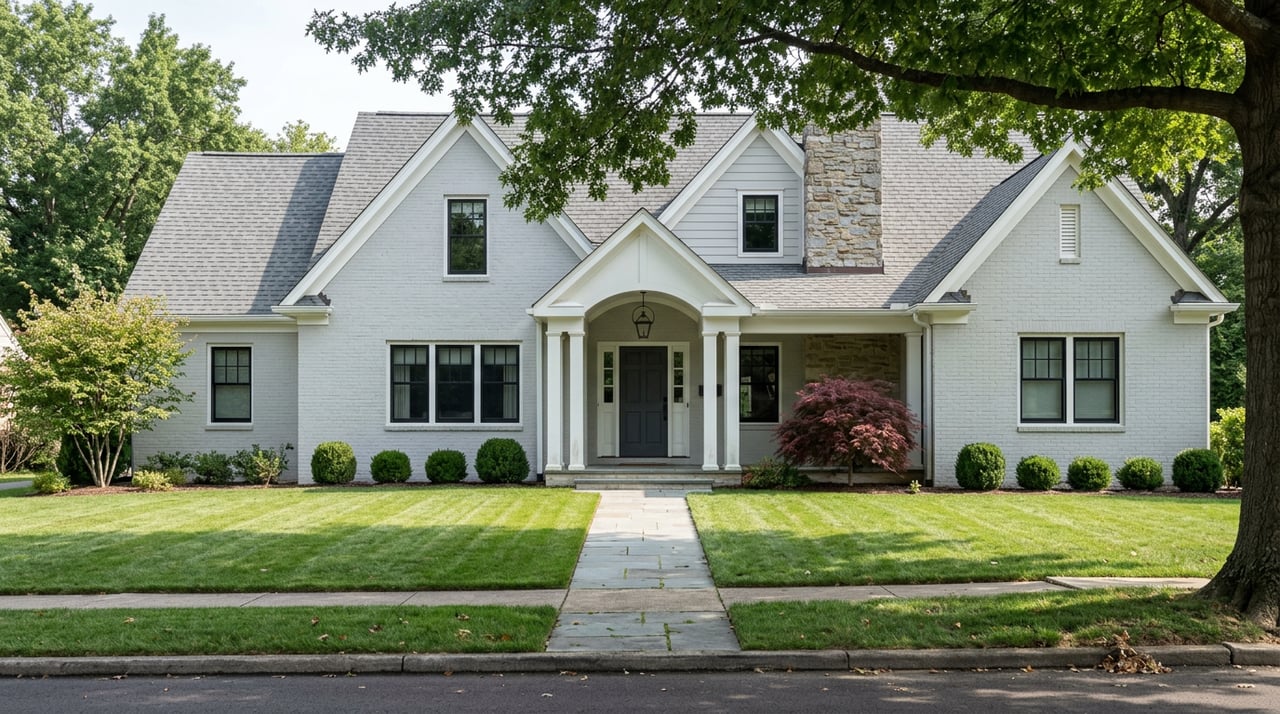
A buyer working with our team last spring had already made up her mind before she called. She wanted Clarendon Hills, because everyone she'd talked to described it the same way: same high school as Hinsdale, same District 86 diploma, tens of thousands of dollars cheaper to get there. She had two addresses bookmarked, three blocks apart, and assumed the pricing difference between them was noise. It wasn't. One fed Hinsdale Central. The other didn't feed a Hinsdale-track elementary school at all.
That's the part of the Clarendon Hills story that rarely makes it into the pitch. The village is small enough that people talk about it as a single unit, a discount version of its famous neighbor. But Clarendon Hills isn't one boundary. It's at least two, and the line between them runs through ordinary residential blocks with no sign marking it.
The pitch, and where it's true
The comparison itself isn't wrong. Over the three months ending in June 2026, Hinsdale's median sale price stood at $1.4 million, up nearly 5 percent year over year. Ask five different sources what the equivalent Clarendon Hills number is for that same stretch of 2026 and you'll get five different answers, ranging from the mid-$700,000s to the high-$800,000s depending on whether the figure is a median sale, a median list, or an average that gets pulled around by a single high-end new build. Wherever you land in that range, the gap to Hinsdale is real and substantial, and it's the reason Clarendon Hills gets marketed as the value play for families chasing Hinsdale Central High School without the Hinsdale price tag. That the "same" number moves by well over $100,000 depending on which site you check is itself worth remembering, and we'll come back to why.
For most of the village, that pitch holds up. Clarendon Hills sends its high schoolers to Hinsdale Central through Community Consolidated School District 181, the same district that covers Hinsdale itself and reaches into parts of Burr Ridge, Oak Brook, and Willowbrook. Inside District 181, Clarendon Hills kids attend Prospect School or Walker School for elementary grades, then Clarendon Hills Middle School, before landing at Hinsdale Central alongside kids from the town next door.
What the pitch leaves out is the word "most."
The sliver nobody mentions
Part of Clarendon Hills sits inside a different elementary district entirely: Maercker School District 60, which feeds Holmes School, Maercker School, and Westview Hills Middle School, none of which are on the path to Hinsdale Central. A house on that side of the village can carry a Clarendon Hills mailing address, a Clarendon Hills price tag, and a completely different school assignment than the one buyers assume comes standard with the village name.
This isn't a hypothetical edge case. It's the kind of detail that shows up mid-transaction, after an offer is written, when someone finally checks the district boundary map instead of trusting the neighborhood's reputation. For a family whose entire reason for choosing Clarendon Hills is the Hinsdale Central pipeline, that's not a footnote. It's the whole deal falling apart on paper, discovered at the worst possible moment. Anyone shopping here with a specific school outcome in mind should confirm the assigned elementary district for an exact address against the District 181 boundary map before writing an offer, not after.
Once you're inside the line that counts, the school stops being the story
Here's the part that surprised us too, once we started digging past the median. Even within the District 181 section of Clarendon Hills, the house-to-house price differences aren't explained by schools at all, because every house in that zone already has the same school assignment. What actually moves price is something the marketing rarely leads with: how close you are to the Metra platform, and how wide your lot is.
Clarendon Hills was laid out differently than most of its neighbors. Rather than following the straight street grid used by Downers Grove Township's older villages, it was built to echo Riverside, the curving, park-like Chicago suburb designed in the 1800s. Long winding streets follow the land's natural contour instead of running block to block. That history is why lot sizes here swing wildly within a few hundred feet of each other. Recent listings have ranged from a 50-by-150 lot a couple of blocks from downtown to a 60-by-193 parcel one block from downtown, and one property advertised itself simply as "115 feet wide" as its headline selling point. Two homes can sit on the same street, feed the same schools, and still price a hundred thousand dollars apart because one lot is nearly double the width of the other.
Layer the train on top of that. The Clarendon Hills Metra station sits in the middle of downtown on the BNSF line, and homes within roughly a ten to fifteen minute walk of the platform carry a premium over otherwise similar houses a mile out. Estimated ride times into Chicago's Union Station vary depending on which source and which train you check, generally landing somewhere between the mid-20s and mid-30s in minutes, and that variance itself is a clue: this is a market where the difference between an express and a local, or a ten-minute walk and a fifteen-minute drive, actually changes what a house is worth.
The village's named pockets reflect this. Prospect Park, one of the oldest sections, trades on walkability and its own elementary school namesake. Blackhawk Heights sits farther out with larger lots and a more suburban feel. Stonegate is a newer cul-de-sac enclave built for space rather than a five-minute walk downtown. Richmond Gardens, on the western side, leans toward classic ranches and split-levels that appeal to downsizers as much as young families. Four names, four different reasons to pay what you pay, none of them the school district.
Why an online estimate can lie to you here
This is also a market where the usual shortcut, the instant online valuation, is more likely to mislead than help. Clarendon Hills is a village of fewer than 9,000 residents, and detached home sales run only in the neighborhood of 90 a year, which works out to fewer than eight closings a month across the entire village. That's the structural reason five different sites can't agree on a median: automated valuation tools need volume to build reliable comparisons, and a market this thin doesn't give them enough same-street, same-lot-size sales to draw from. The practical effect is that two houses three blocks apart, one near the platform on a wide lot and one a mile out on a narrow one, can get treated as roughly equivalent by an algorithm that has no way to weigh the difference. If you're pricing a sale or sizing up an offer here, that's a reason to lean on comparable sales pulled block by block rather than a single automated number, whichever website it came from.
There's a second wrinkle worth knowing if you're comparing offers: homes here have generally been moving fast, with days on market clustering in the low-to-mid 20s as of mid-2026. In a market moving that fast, on a village this small, a listing price is a starting point for negotiation, not a ceiling, which matters when you're deciding how aggressively to bid on the exact right lot.
What this means if you're comparing Clarendon Hills to Hinsdale
None of this is an argument against Clarendon Hills. It's an argument against shopping it by reputation instead of by address. The village earned its "Hinsdale Alternative" label honestly, and the schools-for-less trade is real for the majority of the village. But "majority" isn't "all," and inside the section where the trade actually applies, the real pricing logic runs through the Metra platform and the width of the lot, not the name on the village sign.
A few questions worth asking before you tour
Does every address in Clarendon Hills feed Hinsdale Central? No. Most of the village sits in Community Consolidated School District 181, which sends students to Hinsdale Central, but a portion falls in Maercker School District 60, which does not. Confirm the assigned elementary district for the specific address, not the village.
Is walking distance to the train really worth paying for, or is that just folklore? It shows up consistently enough in how the local market prices homes that it's worth treating as a real factor, alongside lot width, when two houses look otherwise comparable on paper.
Why would two similar Clarendon Hills homes get different online value estimates than what they actually sell for? With roughly 90 detached sales a year across the whole village, there isn't enough transaction volume for automated models to reliably separate a walk-to-train lot from one a mile out. A hand-pulled comparison of recent nearby sales tends to be more accurate here than an instant estimate.
If you're weighing Clarendon Hills against Hinsdale, or trying to figure out what a specific lot on a specific block is actually worth, that's the kind of block-by-block read that doesn't come from a median or a village-wide label. The Mike McCurry Group has spent decades tracing exactly these lines across Hinsdale and the Western Suburbs. Start your meaningful move with a conversation grounded in your address, not the village average.